
- EN
Introduction: 3D mesh works as an open spacer layer that moves air and vapor under a saddle pad, so breathability depends more on structure than on how thick a pad looks.
After a long ride, most riders and grooms have seen the same thing: the underside of the pad is warm and damp, and the hair beneath it lies flat and wet. That is normal. A working horse produces a lot of heat and sweat, and the pad sits directly between that sweat and the open air. What separates one pad from another is not how thick it looks on the shelf, but how its layers handle air and moisture while the horse is moving. this guide looks at 3D mesh as a material rather than a marketing word — what it is actually made of, how air passes through it, and how it behaves next to woven fabric or foam.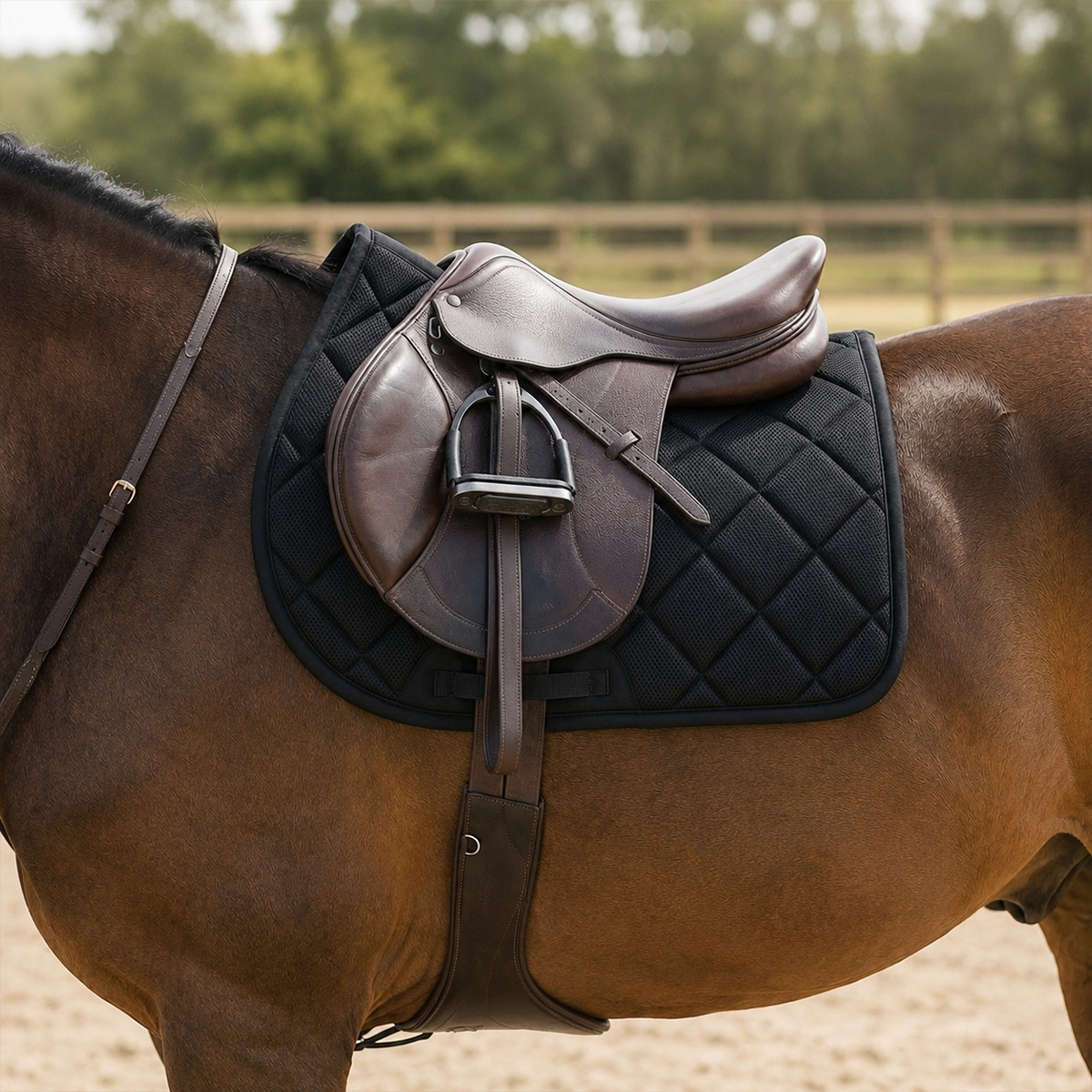
The short answer is that a 3D mesh is not a flat sheet with holes punched in it. It is a spacer fabric, a knitted material built from two separate surface layers that are held apart by a set of connecting yarns. Those yarns work like tiny columns, so the two faces never collapse into each other the way two layers of ordinary fabric would. The gap between them becomes a network of open channels running sideways through the material, not just straight through it from top to bottom. That third dimension — the depth that gives 3D mesh its name — is the part that actually matters. A flat fabric can only pass air where it happens to be porous, and even then, there is nowhere for the air to travel once it gets inside. Under a saddle pad, air movement is driven by pressure and temperature. Every stride changes the shape of the contact area between the pad and the horse's back, which pushes air through the mesh the way a bellows works: squeezing it out on one side and drawing it back in on the other. Warm air rises and cooler air replaces it. The open structure gives that moving air somewhere to go. Press the same force into a flat woven layer and the fabric has almost no internal space, so air stays trapped against the coat. The mesh does not generate airflow by itself. It gives the airflow a path. Studies on heat buildup under equestrian saddle areas and broader research into thermal regulation point in the same direction: heat and moisture accumulate wherever air cannot move. That makes the internal geometry of the surface layer more important than most riders expect.
Thickness is the easiest property to notice, which is exactly why it gets overrated. A thick pad looks like it will cushion, protect and breathe all at once. In practice, those are three different jobs, and thickness only reliably does one of them. Padding comes from the foam layer, which compresses and absorbs the impact of saddle and rider. Breathability comes from how the surface structure manages sweat and vapor. A thick pad with a tight, nonporous surface can trap heat and moisture just as effectively as a thin one. A slimmer pad built from open mesh and a wicking lining can move more vapor away from the coat, even though it looks less substantial on display.
A moisture-wicking fabric does not stop a horse from sweating, and it is not supposed to. It changes where the sweat ends up. Wicking relies on capillary action: liquid travels along narrow spaces between fibers, pulled from wetter areas toward drier ones. Synthetic fibers such as polyester are common here because they absorb very little water themselves, letting moisture travel across the surface and spread over a wider area instead of pooling in one spot. Spreading matters more than soaking. A thin film of sweat spread across a large area evaporates far faster than a dense patch pressed against skin. That is why a wicking layer usually touches the coat, with the mesh sitting behind it. Materials that sit against a horse for hours are also produced under textile safety frameworks such as OEKO-TEX STANDARD 100, which sets limits on certain substances in finished textiles and is a useful reference point when comparing fabrics.
Most of the heat a working horse produces leaves the body as water vapor carried in sweat and breath. If a pad traps that vapor, the air next to the coat stays humid and warm no matter how much cushioning sits underneath. The spacer channels in a 3D mesh give vapor a route out. Under load, the mesh compresses slightly, but the connecting yarns still hold the two faces apart enough to keep open space inside. That space acts as a reservoir and a path at the same time: vapor enters the channels, mixes with cooler air already there, and exits through the edges of the pad where the mesh meets open air. Compression does reduce channel volume, so a pad that fits correctly and is not over-tightened keeps more of the structure working as designed.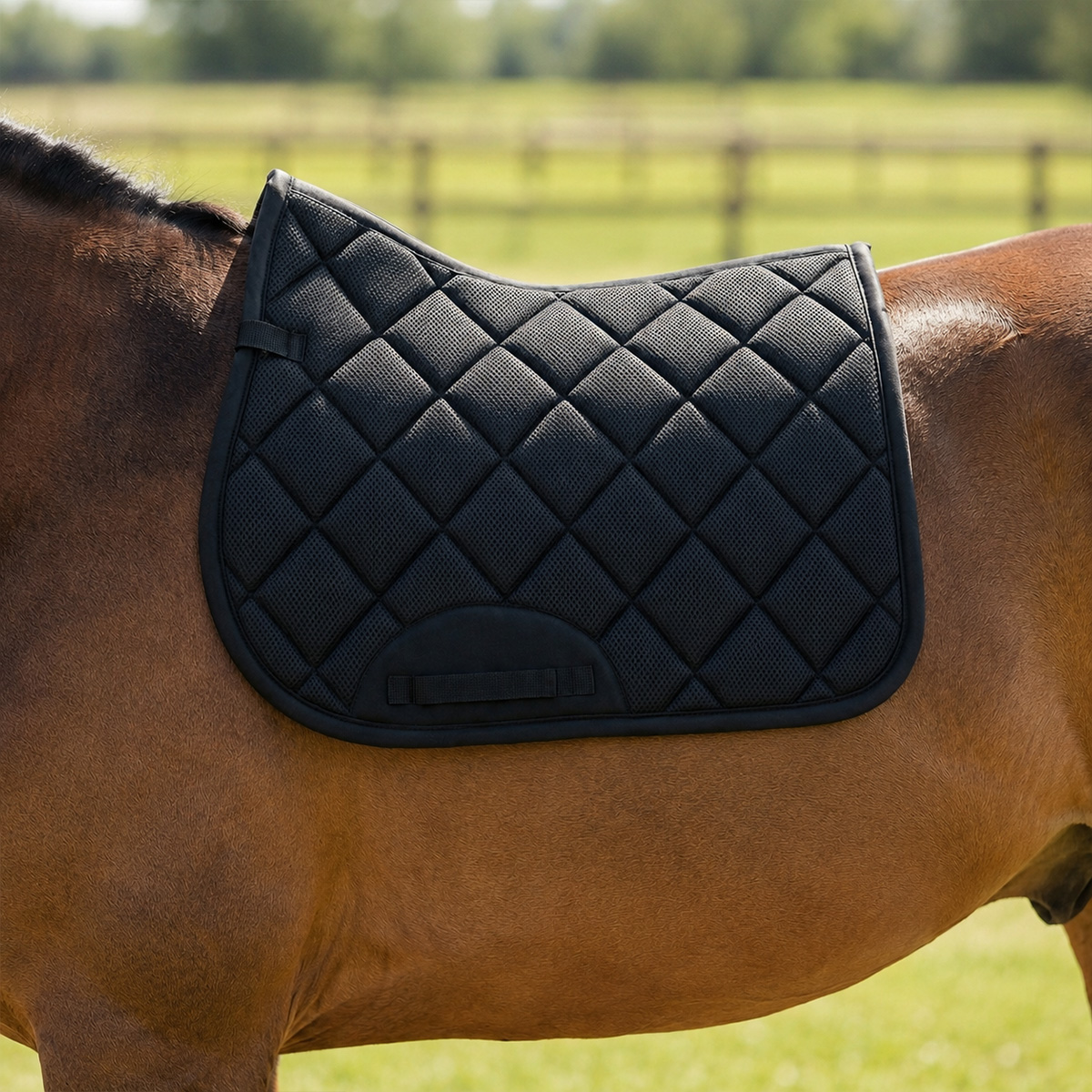
Flat woven fabric is a single plane. Its warp and weft yarns cross each other at one level, so there is no depth to hold air. When weight presses it against the horse, the fabric flattens against the coat and the contact area grows. More contact means less room for air and more surface for sweat to sit on. That is why flat woven materials appear often in decorative or light-use pads but are rarely chosen as the surface layer of a breathable one. Two flat layers stitched together do not create channels either; without connecting yarns to hold them apart, they simply press together under the saddle. Foam belongs to a different part of the stack. High-density foam is a cushioning material: it compresses under the saddle, spreads pressure, and returns to shape. Its job is shock absorption, not ventilation. Some foams have open cells and pass a little air, but the layer was never designed as an air path. In a well-planned pad the roles stay separate — 3D mesh on the surface where airflow and sweat management matter, foam in the middle where load is absorbed. A mesh panel should not be treated as the shock-absorbing core of a saddle pad, because that is simply not what the structure does. The Trianglewin-9125 pad is documented with breathable 3D mesh panels and a moisture-wicking fabric, with high-density foam listed separately as the cushioning layer. That split is the practical version of the whole idea: mesh handles airflow and moisture movement at the surface, foam handles pressure underneath. Anyone comparing breathable horse saddle pad options can apply the same logic and ask which layer does which job, rather than assuming the thickest pad must also be the coolest one.
Airflow under a saddle pad is a structural property, not a label. The open spacer construction of 3D mesh holds air channels in place under load, a wicking lining moves liquid sweat off the coat, and together they support heat and vapor movement while the horse works. None of that replaces good fit, sensible workload management or a suitable foam layer — those stay their own separate jobs. When comparing breathable saddle pads, look at how the surface layer is built and what sits behind it. Readers who want to see how mesh, wicking fabric and a foam core are arranged in one documented example can review the product record for specifics.
A: A 3D mesh is a spacer fabric made of two surface layers joined by connecting yarns that hold them apart, creating open channels through the material. Air can move sideways inside those channels instead of being trapped at the coat. As the horse strides, the changing contact area under the saddle pushes air through the mesh like a bellows, and warm air rises out through the edges of the pad.
A: No. They sit in different parts of the pad and do different jobs. High-density foam compresses to absorb impact and spread pressure, so it is a cushioning layer. 3D mesh is an open spacer structure designed to let air and vapor move. Some pads use both, with mesh on the surface and foam in the middle, and the mesh should not be described as the shock-absorbing core.
A: Yes, and the two work together. Mesh moves air and vapor, but it does not pull liquid sweat off the coat by itself. A wicking lining uses capillary action to spread sweat across a wider area so it evaporates faster. Airflow then carries the vapor away. Remove either layer and the system becomes less effective, especially during hard work in warm conditions.


