
- EN
Introduction: A custom saddle pad is built around specific size, color, logo, or fabric choices rather than a single standard stock design.
For a first-time horse owner, the word custom can be confusing. It sounds like the pad is made to measure for a particular horse, or like the only real change is a logo stitched on the side. In practice, custom saddle pads sit between a plain standard pad and a private label product, and understanding that middle ground makes it much easier to compare what different sellers actually offer. The next sections explain the category in plain language, then look at the basic choices and the material layers that shape how a pad feels and performs.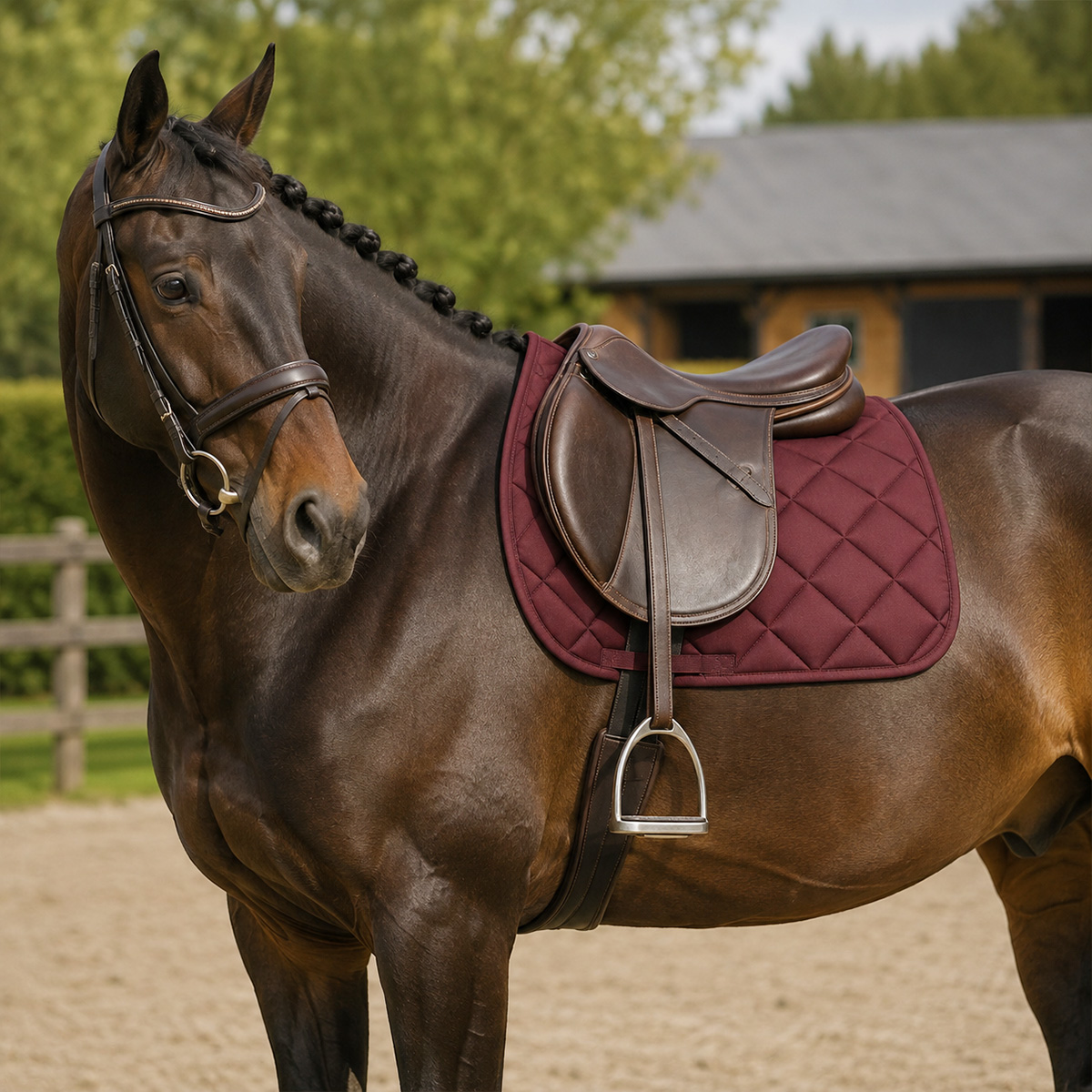
A standard saddle pad is a ready-made pad sold in a fixed set of sizes and colors. It has a simple job: sit between the saddle and the horse, provide a clean interface, absorb some sweat, and add a basic layer of cushioning. Most standard pads use common shapes and fabrics. They are easy to buy, easy to replace, and consistent from one unit to the next. That consistency is the main advantage. The main limitation is that the buyer chooses from what exists, not from what the horse, saddle, or brand actually needs. A custom saddle pad starts with the same basic function but opens up certain production inputs. The buyer can influence size, color, logo, and fabric selection. In some cases, a custom pad also includes structural choices such as mesh panels, foam layers, or spine channels. A private label saddle pad is a related idea: it is a custom or semi-custom pad made to carry a brand’s own name, logo, or packaging. The difference is focus. Custom describes the product changes; private label describes whose brand appears on the finished item. A common first-time buyer mistake is to confuse a custom saddle pad with a made-to-measure saddle. A pad can support comfort and fit, but it does not replace correct saddle fit. Knowing which term you are dealing with changes the questions you ask. If you are comparing standard pads, you compare fixed sizes, colors, and materials. If you are looking at a custom saddle pad, you compare what can be changed and how those changes affect the final product. If you are looking at a private label saddle pad, you also compare branding, packaging, and logo methods. The same pad can be discussed in all three ways, but the useful information is different in each case. For a first-time buyer, this prevents a common mistake: assuming that custom automatically means better, or that a logo is the only thing that makes a pad custom.
Customization sounds broad, but most beginner-level conversations come down to four practical choices. Each one changes what the factory or supplier needs to prepare, so each one affects how a project is planned.
These choices are the basic language of custom saddle pad conversations. They do not require a buyer to understand factory workflow. They simply explain what can change, and why two pads that look similar online can be built quite differently.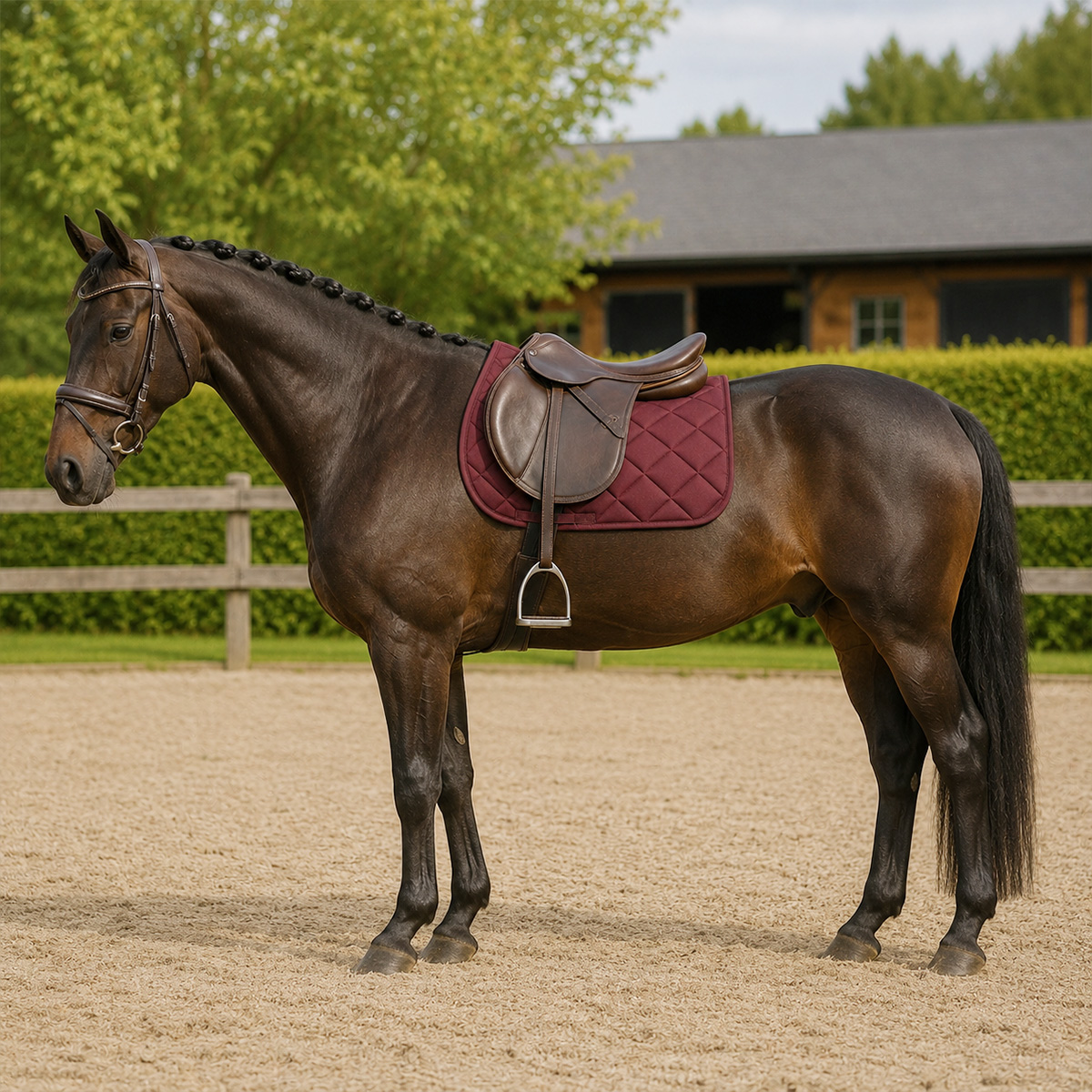
The functional side of a custom saddle pad comes from layers. A breathable 3D mesh panel is usually placed where airflow and sweat management matter. The mesh creates space for air to move and helps moisture move away from the horse’s back. Under that, a high-density foam core absorbs compression and vibration. The foam is not just soft filling; it is a structural layer that spreads pressure and cushions the ride. A contour spine channel runs along the midline and creates clearance over the spine. Non-slip silicone grip borders add friction between the pad and the saddle, while reinforced billet straps connect the pad to the saddle’s billet system. These layers are designed to work as a system. Mesh supports airflow. Foam manages compression. The spine channel protects the midline area. Silicone grip and billet straps help keep the pad in place. A product like Trianglewin-9125 shows how these features can appear in a custom saddle pad: full and custom sizes, custom colors, logo embroidery or printing, breathable 3D mesh panels, a high-density shock-absorbing foam core, contour spine channels, non-slip silicone grip borders, and reinforced billet straps. The goal is comfort and stability, not a medical correction. A custom pad can support a well-fitted saddle, but it does not replace correct saddle fit or guarantee injury prevention.
Custom saddle pad is a category term, not a promise of a miracle product. A standard pad gives you a fixed, ready-made option. A custom saddle pad lets you choose size, color, logo, and fabric, and sometimes structural layers such as mesh, foam, and spine channels. A private label saddle pad is simply a custom or semi-custom pad that carries your own brand. For first-time horse owners and riders, the useful takeaway is to separate product changes from brand ownership and to treat padding as support, not as a replacement for saddle fit. Readers who want to see how these features appear in a real product can review the Trianglewin-9125 product record for specification details.
A: A custom saddle pad is defined by product changes such as size, color, logo, and fabric. A private label saddle pad is defined by whose brand appears on the finished item. A private label pad is often also a custom pad, but the terms answer different questions. One asks what is different about the product; the other asks whose name is on it.
A: A custom saddle pad can add comfort, cushioning, and stability, but it does not change the underlying fit of the saddle. If a saddle is too narrow, too wide, or unevenly balanced, a pad is not a correction. A pad works best as part of a properly fitted saddle system.
A: 3D mesh adds a breathable layer that supports airflow and helps move moisture away from the horse’s back. It is often used on the surface or contact side of the pad where sweat and heat build up. It works together with foam, spine channels, and grip features rather than as a standalone performance guarantee.
Non-profit Equine Association | American Youth Horse Council, Inc.


