
- EN
Introduction: High-density foam cores sit in the middle of many shock-absorbing saddle pads, and their behavior under saddle pressure explains most of what riders feel on a horse's back.
Many pads feel wonderful in the hand and disappointing under a saddle. The reason is usually not the fabric and not the stitching — it is what happens inside the foam layer when a rider's weight lands through it. Understanding that layer helps product researchers and buyers comparing a custom saddle pad against a plain cotton one tell the difference between a pad that looks thick and a pad that actually spreads load. The compression and rebound mechanics of a dense foam core are worth walking through, along with why density and thickness do genuinely separate jobs.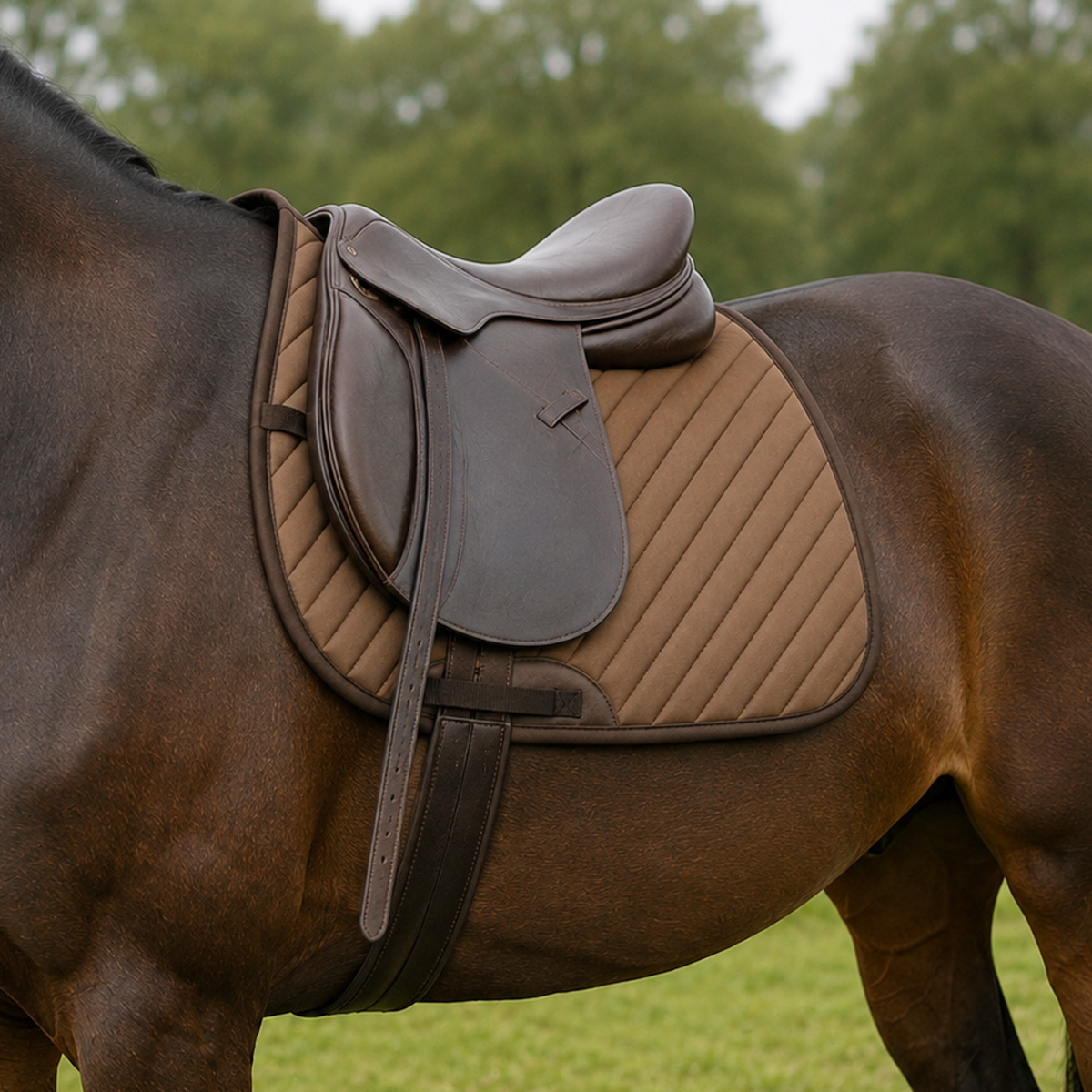
The foam core is the middle layer of a saddle pad, sitting between the fabric that faces the saddle and the lining that contacts the horse's back. That position is not accidental. It is the layer where vertical load concentrates, because the saddle pushes down from above while the horse's back pushes up from below. A high-density foam core is chosen for this position because it resists collapsing under that load long enough to widen the contact patch. The rider's weight, the saddle tree, and the horse's movement all meet at this layer, and the foam decides how evenly that meeting is distributed. Trianglewin-9125, for example, is documented with a high-density shock-absorbing foam core placed in exactly this middle position. Soft filling behaves very differently in the same position. Loose fiberfill and light batting are mostly air held in a thin web of fiber. They feel plush because the fiber moves aside easily, but that same easy movement means they offer little resistance once a real load arrives. Under a rider, a soft fill compresses fast at the highest point of pressure and stops spreading load. The rider then sits effectively on the horse's back through a thin, flattened layer. A dense foam does not collapse as quickly, so pressure spreads wider across the back for longer before the foam reaches its compressed limit. That difference is mechanical, and a horse usually shows it the first time it moves out.
Every stride puts the pad through the same two-phase cycle. First the foam compresses as the rider's weight loads it, then it rebounds as the load eases and the horse moves underneath. How the foam behaves in each phase decides what the rider feels and how the pad recovers for the next stride. Compression governs how the load spreads across the back; rebound governs how the pad returns to shape between strides. Neither phase is visible on a spec sheet, but both are easy to notice the moment a horse starts working.
Compression is simply the foam getting thinner under load. What matters is not whether it compresses — every foam does — but how that compression is distributed. A high-density foam resists the first part of the compression, which keeps the contact patch larger and forces more of the back to share the load. A low-density foam gives way almost immediately, so load concentrates on the highest point of the back and less of the surrounding area is involved. This is why a pad can pass a hand-squeeze test and still collapse under the weight of a rider and saddle. A hand does not apply the same pressure, and it does not apply it for hundreds of strides.
Rebound is the foam returning to its original thickness once the load eases. Riding is not a static event — the load rises and falls with each stride, so the foam cycles through compression and recovery continuously. A foam that rebounds quickly comes back to full thickness and can spread load again on the next stride. A foam that rebounds slowly stays partly compressed, and each stride starts from a slightly thinner starting point. The energy lost during each cycle is called hysteresis, and it shows up as heat inside the pad. Foams with high hysteresis feel damped and quiet but run warmer; foams with lower hysteresis return more energy and feel springier. Both behaviours can work in an ordinary ride, but the rebound pattern is what makes a pad feel fresh or flat over a long session.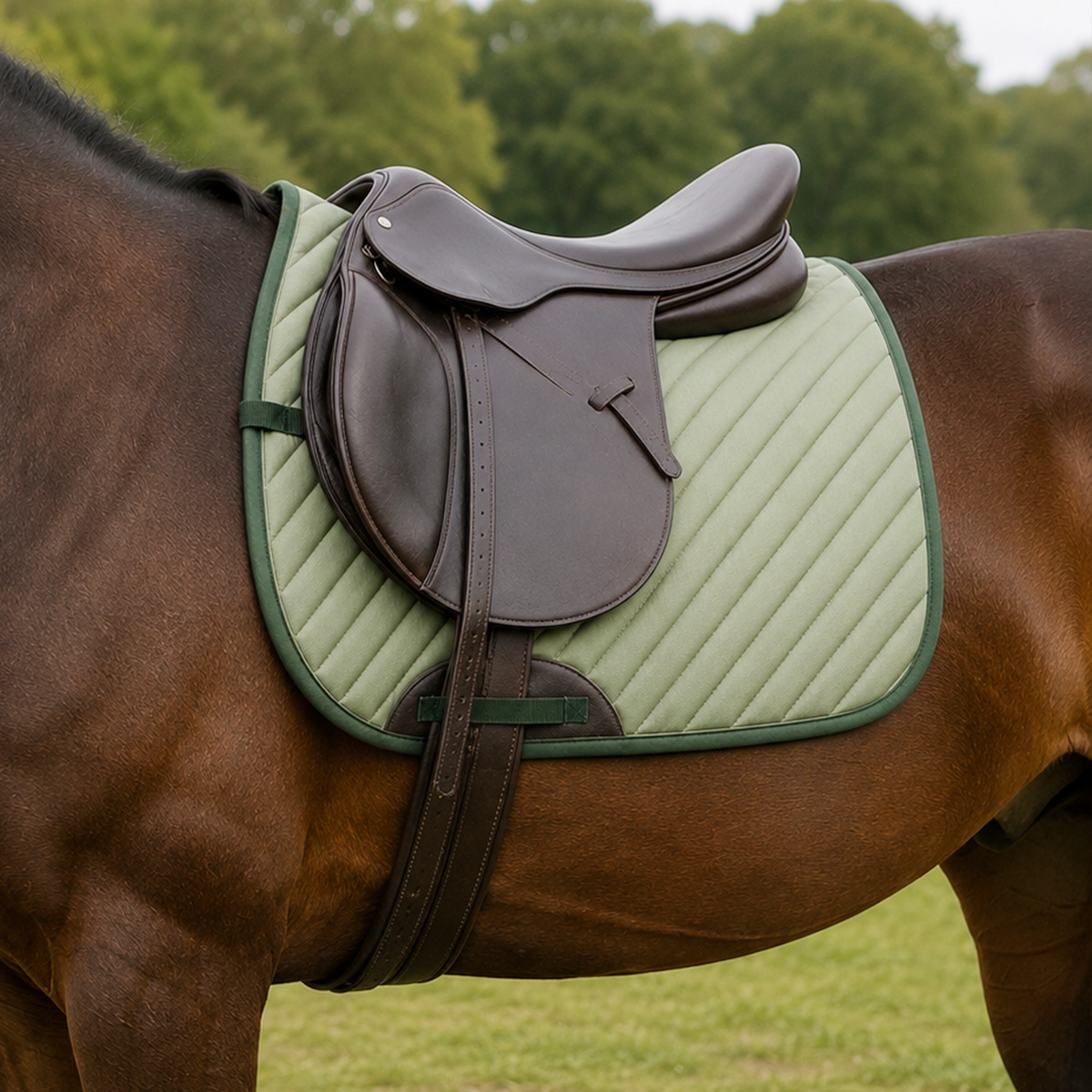
It is common to assume that a thicker pad must absorb more shock and that a thinner pad must be firmer. Density and thickness are different properties, and they solve different problems. Thickness sets the maximum distance the foam can travel before it bottoms out — its compression range. Density sets how much resistance the foam offers within that range, and how it distributes load along the way. A thick, low-density foam can feel generous in the hand, then compress all the way through under a rider and stop spreading pressure. A thinner, higher-density foam can spread load well within a short travel because it resists compression earlier. The right combination depends on the saddle and the horse, and stacking too much thickness can change how the saddle sits, which adds pressure somewhere else. That is why buyers comparing wholesale horse saddle pad options check density and thickness side by side rather than treating one as a proxy for the other. Thickness tells you how much room the foam has to work in; density tells you what it does with that room. A pad that combines moderate thickness with a genuinely dense core can produce a firmer, more supportive feel than a much thicker pad built from lighter filler. For anyone evaluating a custom saddle pad, the useful question is not how thick the foam is, but how the foam behaves at the pressures a rider actually produces. The listed specification for Trianglewin-9125 names a high-density shock-absorbing foam core; the specific foam type and density grade are not published, so general foam behaviour is the right way to read it.
A high-density foam core earns its place in the middle of a saddle pad by controlling what happens in the layer where load meets the back. It compresses more slowly than soft fill, spreads pressure across a wider area, and recovers between strides so the next stride starts from full thickness. Density and thickness both matter, but they are not interchangeable — thickness sets the working range, density decides the resistance. For product researchers comparing options, the practical habit is to read a pad's foam layer as a set of behaviours rather than a single number, and to ask a saddle pad manufacturer how a specific core is specified before assuming thickness alone tells the story.
A: It sits in the middle layer and takes the vertical load coming through the saddle. Because the foam resists compression, it keeps a wider area of the back in contact with the pad for longer before the foam bottoms out. That spreads pressure more evenly than a soft fill, which collapses quickly under a rider. The foam also rebounds after each stride, so the pad returns to full thickness and can spread load again.
A: Soft filling is mostly air held in a thin fiber web, so it feels plush but compresses almost immediately under load and stops spreading pressure. High-density foam packs more material into the same volume, so it resists the early part of compression and keeps load spread wider. The practical result is that a soft fill can look thicker than a dense foam pad yet deliver less support once a rider is aboard.
A: No. Thickness sets how far the foam can compress, but density decides how it behaves during that compression. A thick, low-density foam can bottom out under a rider and stop spreading load, while a thinner, high-density foam can spread load effectively within a shorter travel. Too much thickness can also change how the saddle sits and create pressure elsewhere, so thickness and density need to be judged together.


